
Double Acting vs Spring Return Pneumatic Actuator: Fail-Safe Logic Explained
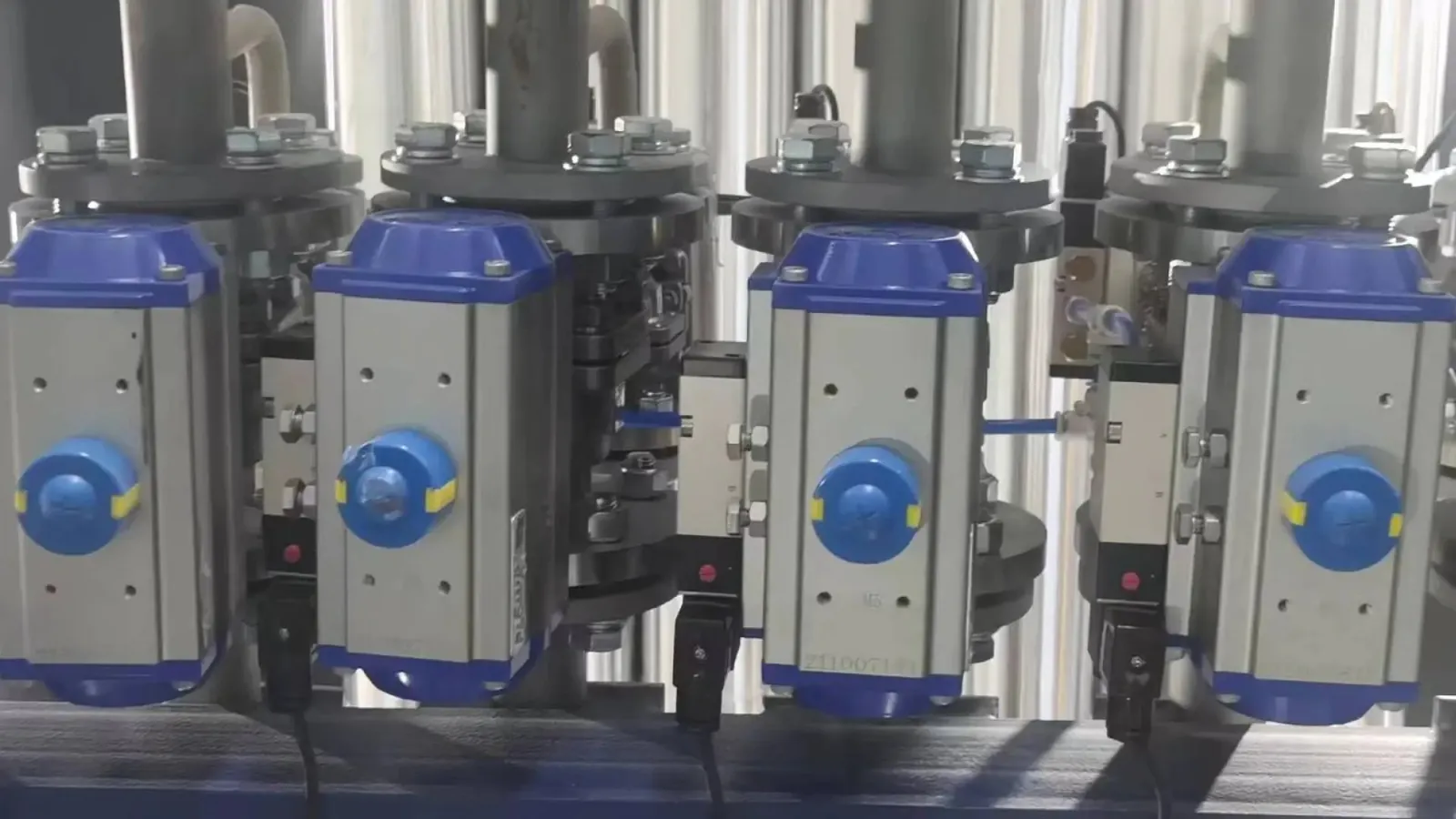
Table of Contents
Most buyers who search "double acting vs spring return" already know both names — the question they are really asking is: when the air supply stops, what does my valve do? That single question decides which of the two designs fits a process. Double acting actuators push air into one cylinder chamber to open the valve and into the other to close it. Spring return (single acting) actuators use air for one stroke and a compressed spring cartridge for the other, so the valve moves to a defined safe position on its own when pressure drops.
This guide covers the working principle of each design, the FC (fail closed) and FO (fail open) positions in plain terms, where the torque numbers actually differ, how safety logic drives the choice, and a side-by-side comparison table you can hand to your procurement team. Both designs from PNEUMACTUATOR follow the ISO 5211 valve mounting standard and the NAMUR VDI/VDE 3845 accessory interface, so the mechanical fit with your valve is the same either way — the difference sits inside the actuator. For the wider picture, start with our complete pneumatic actuator buyer manual.
Keep reading for more!
The Snapshot
- Double acting: air opens, air closes. No springs, so full supply-pressure torque is available in both directions.
- Spring return: air does one stroke, springs do the other. The valve parks in a fail-safe position — closed or open — when air is lost.
- Fail position is a process-safety decision, not a hardware preference. Fuel and chemical lines commonly fail closed; cooling water and ventilation commonly fail open.
- Springs consume part of the air torque, so a spring return actuator is often one size larger than a double acting unit for the same valve.
- Double acting holds its last position on air loss — or drifts, depending on process forces. A lock-up valve adds fail-in-last-position behavior.
- Both types share the same ISO 5211 flange and NAMUR solenoid pad, and both are available in rack and pinion or scotch yoke mechanisms.
What Each Design Is
A pneumatic quarter-turn actuator converts compressed air into 90° rotary motion to drive ball, butterfly and plug valves. The mechanism — rack and pinion, scotch yoke, or vane — determines the torque profile; the air circuit determines the failure behavior. That second part is where "double acting" and "spring return" split.
Double acting means pressurized air performs both strokes. The PNEUMACTUATOR DA series covers output torque from 10 Nm to 4000+ Nm at 2–8 bar supply pressure, with balanced torque in both rotation directions. It has no springs and no inherent fail-safe function.
Spring return (single acting) means air performs one stroke while a spring cartridge performs the return. The PNEUMACTUATOR SR series covers 8–1000+ Nm of air-stroke torque with selectable spring torque, in spring-to-close (FC) and spring-to-open (FO) configurations. Spring sets use 4–12 springs per side with adjustable pre-load.
Neither design is tied to one mechanism: our AT series rack and pinion actuators ship in both double acting and spring return versions, and scotch yoke units cover the high-torque end of both lines. If you are choosing between mechanisms as well as air circuits, see rack and pinion vs scotch yoke.
How a Double Acting Actuator Works
In a rack and pinion double acting actuator, two pistons sit in opposite cylinder chambers and drive a central pinion through a rack. Pressurizing chamber A moves the pistons inward and rotates the pinion 90° in one direction; pressurizing chamber B reverses the stroke. Because both strokes are powered by air, output torque is roughly proportional to supply pressure in both directions, with no spring force working against you.
That even torque profile makes double acting units a practical fit for modulating service: paired with a positioner, the actuator responds symmetrically in both directions. It is also the usual choice for frequent cycling, where spring compression would add fatigue to every stroke. Our accessories guide covers positioners, NAMUR solenoid valves and limit switch boxes that complete this setup.
The trade-off is failure behavior. When supply air drops, a double acting actuator has no stored energy to move the valve — it holds its last position if process forces are balanced, or drifts if the valve is unbalanced. For processes where "stay where you are" is the safe state, a lock-up valve traps air in the chambers and holds the position deliberately. That is a common compromise, but it is still an engineered add-on, not an inherent property of the design.
How a Spring Return Actuator Works
A spring return actuator runs two strokes with two different energy sources. During the air stroke, supply pressure pushes the pistons and compresses the springs; output torque at any point equals air torque minus the spring force resisting it. During the spring stroke, the compressed spring cartridge drives the pistons back and rotates the valve to its safe position — no air, no electricity, no operator required.
The direction of the fail stroke is set by how the spring cartridge and piston arrangement are configured. Air-to-open with spring-to-close gives fail closed (FC); air-to-close with spring-to-open gives fail open (FO). Because the springs return the valve, the unit must be sized so the spring torque at the critical positions — unseating and seating the valve — comfortably exceeds the valve's requirement. Our spring return working principle guide walks through the two-stroke sequence in detail.
Spring pre-load is adjustable on the SR series, which lets the installer fine-tune seating torque without changing parts. A practical consequence of the design: the actuator needs enough supply pressure to overcome the spring pre-load before the air stroke moves anything, which is why spring return units typically list a higher minimum pressure (3–8 bar for the SR series) than double acting units (2–8 bar).
Fail Positions and Safety Logic: FC vs FO
Fail position is shorthand for "where does the valve go when everything else stops?" It is defined by the process safety requirement, and it is the first thing to settle before comparing actuators.
- FC — fail closed. The valve closes on air loss. Common where an open line creates risk: fuel and gas feeds, chemical dosing, steam, pressure vessels. Emergency shutdown (ESD) valves in oil and gas service are the classic example.
- FO — fail open. The valve opens on air loss. Common where a closed line creates risk: cooling water to heat exchangers, ventilation and purge systems, some fire-protection water lines where keeping flow available matters more than containing it.
- FL — fail last. The valve holds its current position. This is not a spring return function; it is typically implemented on a double acting actuator with a lock-up valve. It suits processes where an abrupt move in either direction is worse than staying put.
The FC or FO choice normally comes from a process hazard review, not from the actuator supplier — but the supplier should be able to deliver either configuration cleanly. PNEUMACTUATOR supplies the SR series in both spring-to-close and spring-to-open arrangements, with documented spring torque so your safety instrumented system (SIS) design can be reviewed against real numbers. For SIS duty, a common practice is periodic partial stroke testing to confirm the springs still deliver their rated torque; our maintenance guide covers that routine.
One more note: fail position is specified at purchase. A spring return unit ordered as FC can often be reconfigured or re-mounted for FO, but it is not a field toggle — state the fail position, valve model and rotation direction on the order, and keep the spring set spec in your records.
Torque Differences: Where the Spring Tax Goes
For the same valve and the same supply pressure, a spring return actuator delivers less usable torque than a double acting unit of the same size — the springs eat part of the air force during the power stroke, and the return stroke runs on spring torque alone. Two consequences follow.
First, spring return actuators are commonly sized one size larger (or more) than the double acting equivalent for a given valve. A valve that needs 300 Nm of breakaway torque might take a double acting unit rated at 300+ Nm at your line pressure, while the spring return version needs a body whose air-stroke torque minus the required spring torque still clears 300 Nm at every point of the stroke. Second, the torque margin strategy differs: with a double acting unit the safety factor applies to air torque; with spring return it has to cover spring tolerance, pre-load setting and worst-case seating torque at the end of travel, where spring force is at its lowest.
As a starting point, sizing practice commonly uses a safety factor of 1.25–1.5 over valve breakaway torque for double acting service, and a higher margin for spring return to absorb spring variation. The exact number depends on the valve torque curve and the standard you work to — our step-by-step torque calculation guide walks through breakaway, running and seating torque for ball and butterfly valves. At the very high-torque end, scotch yoke spring return units exist, but the practical range where spring return stays economical is smaller than double acting — the SR series tops out at 1000+ Nm of air-stroke torque versus 4000+ Nm for the DA series — which is why very large valves often use double acting with lock-up valves when fail-safe holding is required.
Side-by-Side Comparison Table
Keep this table when comparing quotes. It maps the decisions that matter in the field, not the marketing copy.
| Factor | Double Acting | Spring Return (Single Acting) |
|---|---|---|
| Motion source | Air pressure on both strokes | Air on one stroke, springs on the other |
| Fail behavior on air loss | Holds last position (may drift under process forces); lock-up valve adds fail-last | Moves to defined safe position — FC or FO |
| Torque in both directions | Full air torque at supply pressure | Air stroke: air torque minus spring torque; fail stroke: spring torque alone |
| Actuator size for same valve | Smaller | Often one size larger |
| Supply pressure (typical) | 2 – 8 bar | 3 – 8 bar (must overcome spring pre-load) |
| Relative cost | Lower | Higher (spring cartridge, larger body) |
| Air consumption | Air used on both strokes | Higher pressure to compress springs; no air on return stroke |
| Modulating / control | Symmetric response with positioner | Workable with positioner, asymmetric response |
| Typical duty | General process, frequent cycling, modulating | ESD, fire protection, safety loops, lines that must park safe |
| Maintenance | No springs to verify | Periodic spring torque verification recommended |
Selection Guide and Checklist
Work the decision in this order and the right answer tends to surface quickly.
1. Define the fail requirement first
If the valve must reach a safe position when air and power disappear, start with spring return (FC or FO per your process review). If there is no fail-safe requirement — or if holding position is the safe state — double acting fits, with a lock-up valve where hold is critical.
2. Confirm the torque at your pressure
Get the valve's breakaway and seating torque from the manufacturer, apply your safety factor, then check the actuator torque at the supply pressure you actually have on site — not at the datasheet maximum. A spring return unit's spring torque must clear the valve requirement at end of travel, so ask for the spring torque curve, not just the air-stroke number.
3. Match interfaces and environment
Both designs mount on the same ISO 5211 flange (F05–F25 pattern families for the AT/DA/SR range) and carry the same NAMUR VDI/VDE 3845 pad for a direct-mounted solenoid. Confirm the ambient temperature range — standard service is -20°C to +80°C, with options beyond — and whether you need ATEX versions or SIL documentation for safety loops. The ISO 5211 mounting guide explains the interface in detail.
Buying checklist
- Fail position: FC, FO, or fail-last (with lock-up valve) — stated on the order
- Valve torque: breakaway, running and seating values at operating pressure
- Supply pressure: available plant pressure vs actuator minimum (3–8 bar for spring return)
- Spring torque curve: requested from the supplier for the fail stroke, end-of-travel value included
- Mounting: ISO 5211 flange size, drive type and coupling for your valve stem
- Accessories: NAMUR solenoid, limit switch box, positioner, manual override, lock-up valve
- Environment: temperature range, ATEX zone, corrosion protection, air quality (filtered, lubricated or not)
- Spares: spring set for the SR series, seals, and cycle-life expectation (our AT series is tested to 1,000,000+ cycles)
Questions Buyers Ask
1. What happens to a double acting actuator when air supply fails?
The valve stays in its last position if the forces on it are balanced, or drifts toward the position the process pressure pushes it to. For a defined hold, fit a lock-up valve that traps air in the chambers; for a defined move, a spring return actuator is the direct answer.
2. Which is better — double acting or spring return?
It depends on the fail requirement, not on the hardware. If the process demands a safe position on air loss, spring return is the conventional choice. If it does not, double acting gives more torque per size, a lower price and simpler control. Define what the valve must do when the air stops, and the design mostly chooses itself.
3. Can a spring return actuator be changed from fail closed to fail open?
Yes, but it is a configuration change, not a field toggle: the spring cartridge arrangement and mounting orientation determine the fail direction, and changing it means re-arranging springs or rotating the actuator relative to the valve. Specify FC or FO on the order; PNEUMACTUATOR supplies both arrangements.
4. Why does a spring return actuator cost more?
The spring cartridge adds parts, and the actuator body is typically one size larger to deliver the same net torque. You are paying for stored energy and the fail-safe function it provides — for safety-critical lines that cost is usually easy to justify.
5. Does spring return need higher air pressure?
Typically yes. The supply must overcome the spring pre-load before the air stroke begins, which is why the SR series lists 3–8 bar versus 2–8 bar for the DA series. Check your plant pressure before sizing; a low-pressure line can push you to a larger unit or a different spring set.
6. Can a double acting actuator be used in a safety system?
It can be arranged with lock-up valves and solenoid venting, but the fail-safe behavior is then delivered by additional components rather than by the actuator itself. Where the valve must move on loss of air, spring return is the simpler, more direct path — and a safety engineer should review the complete SIS loop either way.
The Bottom Line
The double acting vs spring return decision is not about which design is stronger — both deliver ample torque for quarter-turn valves. It is about what the valve must do when the air stops. Define the fail position first (FC, FO, or none), then the torque at your actual supply pressure, then the size. Double acting gives you more torque per dollar and simpler control when no fail-safe is needed; spring return builds process safety into the actuator itself when one is. Both mount identically to ISO 5211 valves with NAMUR accessories, so the choice stays where it belongs — in the process requirement, not in the mounting hardware. Send your valve model and operating conditions to the PNEUMACTUATOR team and we will size the right configuration — DA, SR or AT series — and quote it with the spring torque curve included.
Next Step
Ready to Spec Your Valve Actuator Package?
Send us your valve type, torque requirement and air supply — our engineers respond within 24 hours with sizing and pricing.
Written by
Ray ChanActuator engineer & technical writer. Ray helps global importers and integrators source factory-direct pneumatic actuators and valve automation packages.